
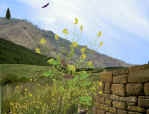
Scientific classification: Mustard is the common name for the family Cruciferae and its representative genus Brassica.
|
Mustard,
common name for a large family of pungent-juiced herbs, important for the
many food plants and other crops it produces, and for its representative
genus. The family contains about 390 genera and 3000 species. It is
worldwide in distribution, but about two-thirds of the species occur in the
Mediterranean region and southwestern and Central Asia. Most members of the
mustard family are annual or perennial herbs; a few are shrubs or climbers.
The mustard family contains a great variety of food plants, including
cabbage, cauliflower, brussels sprouts, broccoli, and kohlrabi, all of which
are varieties of the wild cabbage native to coastal Britain and southern
Europe (Brassica oleracea). Table mustard is prepared from powdered
seeds of two other species, black mustard (Brassica nigra) and white
mustard (Brassica hirta). The family is also an important source of
vegetable oils. Scientific classification: Mustard is the common name for the family Cruciferae and its representative genus Brassica. |
|